Solar Water Heating System for Hotels and Resorts in UAE: Complete Guide for Hospitality Businesses
Introduction
Hotels and resorts in the UAE have a continuous demand for hot water across guest rooms, restaurants, kitchens, spas, laundries, swimming-pool facilities, and staff areas. Meeting this demand through conventional electric or gas-based heating can contribute significantly to operating costs and energy consumption. A solar water heating system for hotels and resorts in UAE offers a practical way to use the region’s abundant solar resource while reducing dependence on conventional water-heating energy sources.
The hospitality sector is also placing greater emphasis on energy efficiency, sustainable operations, and environmentally responsible infrastructure. Dubai’s clean-energy strategy and the UAE’s broader net-zero ambitions are encouraging businesses to evaluate renewable-energy technologies as part of long-term facility planning.
Overview of Solar Water Heating Systems
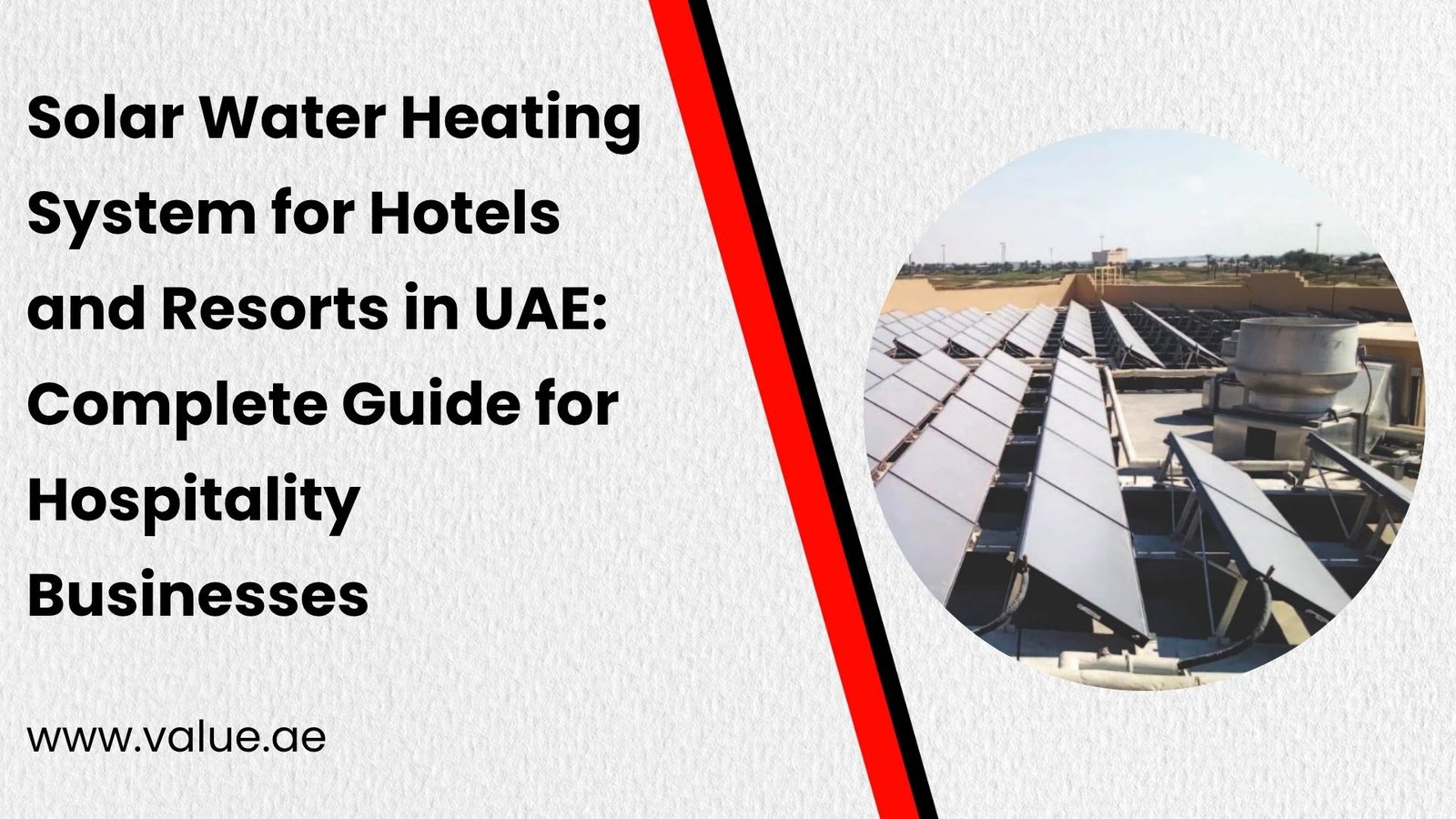
A solar water heating system uses solar thermal collectors to capture heat from sunlight and transfer it to water. The heated water is stored in insulated tanks and supplied to different areas of a hotel or resort according to demand.
For larger hospitality facilities, systems can be designed as centralized installations with multiple collectors, storage tanks, circulation pumps, controls, and backup heaters. Depending on the project, flat-plate or evacuated-tube collectors may be considered.
A properly designed solar water heating system for hotels and resorts in UAE can work alongside existing boilers, electric heaters, or heat-pump systems. This hybrid configuration provides hot water even when solar availability is insufficient.
Key Features
High-Capacity Solar Collectors
Commercial systems can use multiple collectors arranged according to available roof or ground space and the property's hot-water requirements.
Thermal Storage
Insulated storage tanks retain heated water and help match solar heat production with fluctuating hotel demand.
Automatic Controls
Temperature sensors, circulation pumps, controllers, and monitoring systems can regulate water flow and system performance.
Backup Heating
Electric, gas, heat-pump, or boiler-based backup systems can maintain hot-water availability during periods of insufficient solar gain.
Scalable Design
The system can be engineered for different property sizes, from boutique hotels to large resorts with hundreds of rooms and extensive hospitality facilities.
Benefits for Hotels and Resorts
1. Reduced Energy Consumption
Hotels require hot water throughout the day. Solar thermal technology can supply a portion of this requirement using sunlight, potentially reducing the energy required from conventional heating equipment.
2. Lower Operating Costs
Once installed, solar thermal systems use sunlight as their primary heat source. This can reduce the ongoing energy requirement associated with water heating and improve long-term operating economics.
3. Sustainability Goals
Hospitality businesses increasingly want to demonstrate measurable environmental performance. Solar water heating can contribute to broader energy-efficiency and sustainability initiatives.
4. Better Energy Management
A centralized system allows facility managers to monitor hot-water generation, storage temperatures, circulation, and backup heating requirements.
5. Long-Term Infrastructure Value
Solar thermal installations can complement other efficiency measures, including heat pumps, building-management systems, efficient pumps, and solar PV.
Applications and Industries Served
A solar water heating system for hotels and resorts in UAE can serve a wide range of hospitality applications, including:
- Guest-room hot-water supply
- Hotel kitchens and restaurants
- Laundry facilities
- Spas and wellness centres
- Staff accommodation
- Swimming-pool facilities
- Hospitals and healthcare facilities
- Residential and commercial buildings
- Educational institutions
- Industrial and institutional facilities
The commercial and hospitality segment is particularly suitable because facilities often have substantial and relatively predictable hot-water requirements. Market research also identifies hotels, hospitals, malls, schools, and other commercial facilities among important applications for solar thermal technology in the UAE.
Why Solar Water Heating Is Important in UAE Hospitality
The UAE receives strong solar irradiation, making solar thermal technology particularly relevant for hot-water applications. At the same time, the hospitality industry operates facilities where hot-water demand can remain high throughout the year.
The business case is not simply about replacing an existing heater. It involves optimizing the complete hot-water system so that solar energy supplies as much of the thermal load as practical while conventional equipment handles peak or backup requirements.
For procurement teams, this makes the selection of a reliable solar water heating system supplier UAE an important part of project planning. The supplier should understand commercial hot-water demand, local installation conditions, water quality, controls, maintenance, and integration with existing mechanical systems.
Factors to Consider Before Choosing a System
1. Hot-Water Demand
Calculate daily and peak hot-water requirements based on room count, occupancy, restaurant operations, laundry demand, spa facilities, and other loads.
2. Available Installation Area
Evaluate roof orientation, structural capacity, shading, accessibility, and maintenance space before determining collector capacity.
3. Collector Technology
Compare flat-plate and evacuated-tube technologies based on efficiency, operating temperature, durability, maintenance, and project requirements.
4. Storage Capacity
Storage should be appropriately sized to balance solar collection, demand patterns, and backup heating.
5. Water Quality
Water chemistry can influence scaling, corrosion, heat-exchanger performance, and maintenance requirements. Suitable treatment and system materials should therefore be considered.
6. Backup Integration
The solar system should integrate smoothly with existing boilers, electric heaters, heat pumps, or other hot-water equipment.
7. Maintenance and After-Sales Support
Choose a solar water heating system supplier UAE that can provide commissioning, preventive maintenance, replacement components, technical assistance, and performance monitoring.
Latest Industry Trends
The UAE's renewable-energy landscape continues to expand. DEWA reported that its clean-energy production capacity increased substantially during 2025, while the Mohammed bin Rashid Al Maktoum Solar Park continues to expand under the Dubai Clean Energy Strategy 2050.
Within solar thermal applications, current trends include larger commercial systems, centralized hot-water installations, improved collector technology, hybrid heating configurations, and greater integration with green-building objectives.
Hotels and resorts are also increasingly evaluating renewable technologies as part of broader energy-management strategies rather than treating solar water heating as an isolated installation. This creates opportunities for smart controls, performance monitoring, hybrid systems, and better integration with other building-energy technologies.
Why Consider Value Addition?
Value Addition is a suitable consideration for businesses evaluating renewable and energy-efficiency solutions in the UAE. Its focus on practical energy solutions and commercial applications can help businesses approach solar water heating from both technical and operational perspectives. For hospitality projects, working with an experienced provider can help align system sizing, installation requirements, hot-water demand, and long-term performance objectives.
Conclusion
A solar water heating system for hotels and resorts in UAE can be an effective solution for reducing conventional energy dependence while supporting sustainable hospitality operations. The right system should be designed around actual hot-water demand, available installation space, collector technology, storage requirements, water quality, backup heating, and long-term maintenance.
For hospitality businesses planning a new installation or upgrading an existing hot-water infrastructure, selecting the right technology and an experienced solar water heating system supplier UAE can make a significant difference in system reliability and lifecycle performance.
FAQs
1. Is solar water heating suitable for hotels in the UAE?
Yes. Hotels have substantial hot-water requirements, and the UAE's strong solar resource makes solar thermal technology suitable for many commercial hospitality applications.
2. Can solar water heating work with an existing boiler?
Yes. A solar thermal system can be integrated with conventional boilers or other backup heaters to maintain hot-water availability when solar heat is insufficient.
3. What type of solar collector is suitable for hotels?
Flat-plate and evacuated-tube collectors are common options. The appropriate technology depends on hot-water temperature requirements, available space, climate conditions, system design, and project economics.
4. How should a hotel select a solar water heating supplier?
Evaluate technical expertise, system design capability, installation experience, component quality, commissioning support, maintenance services, warranty terms, and experience with commercial-scale projects.
5. Can resorts use solar water heating for more than guest rooms?
Yes. Systems can supply hot water for kitchens, restaurants, laundries, spas, staff facilities, and other areas with significant thermal demand.
CTA
Hotels, resorts, and commercial facilities looking to improve hot-water efficiency can explore a professionally designed solar water heating system for hotels and resorts in UAE with Value Addition. Discuss your project's hot-water demand, site conditions, and energy objectives to identify an appropriate solar thermal solution.
Read More: Solar Water Heating System for Hotels and Resorts in UAE: Complete Guide for Hospitality Businesses
Recent News