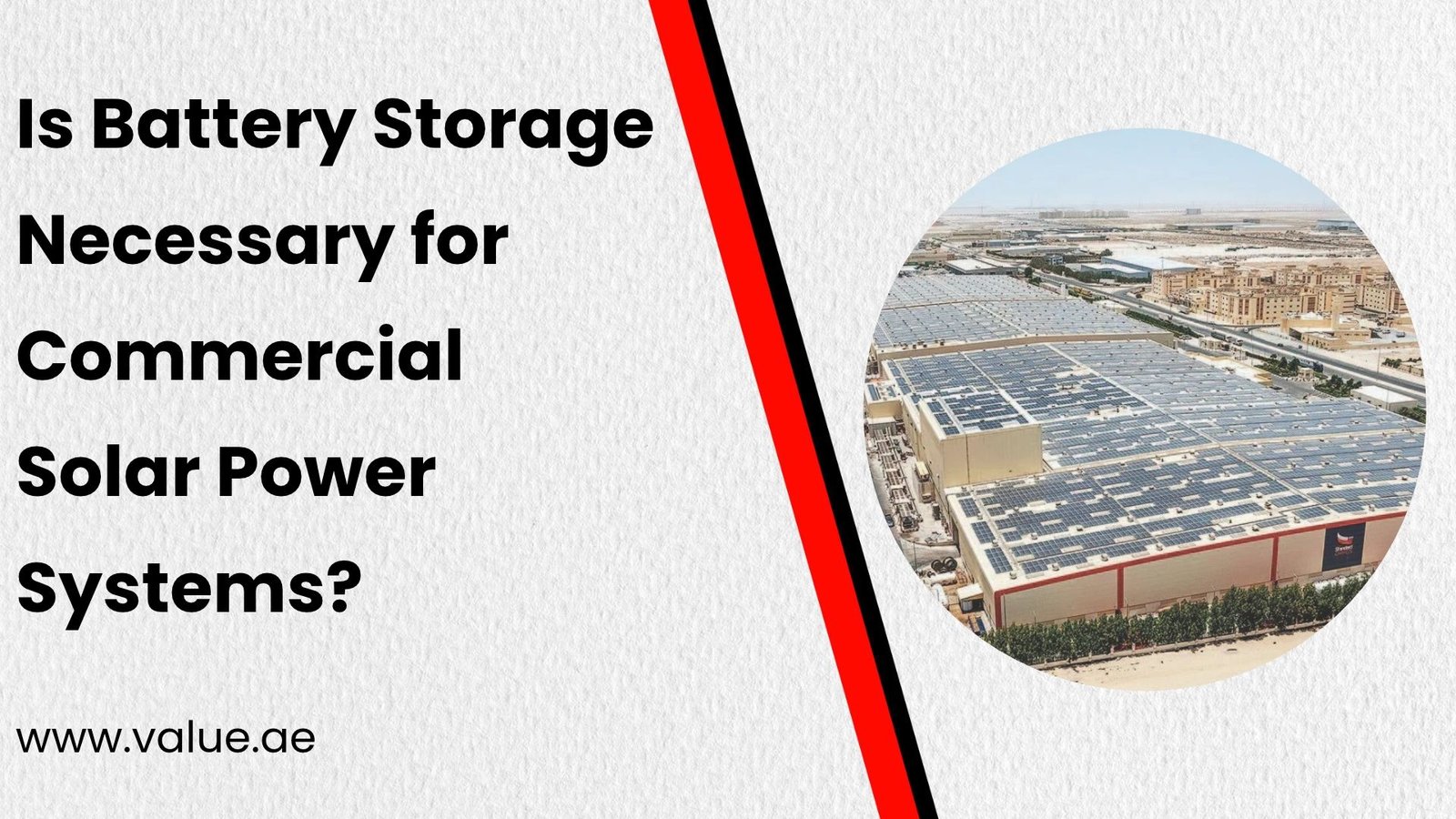
Is Battery Storage Necessary for Commercial Solar Power Systems?
Battery storage is not strictly necessary for most commercial solar power systems in UAE when the facility operates under a net-metering framework that credits excess daytime generation against later grid consumption, yet it becomes a practical and increasingly valuable addition for maximising self-consumption, reducing peak-demand charges, and providing backup resilience.
In the UAE’s high-irradiance environment, a well-designed rooftop or carport solar array already delivers strong daytime savings. The decision to add batteries therefore depends on the emirate’s rules, the building’s load profile, and the business’s priorities around energy independence and cost control.
How Net Metering Changes the Equation
Dubai’s Shams Dubai programme, managed by DEWA, remains the most established route for commercial and industrial customers. Surplus solar electricity exported to the grid is credited at the retail tariff and can offset consumption at other times, effectively turning the grid into a large virtual battery. Many offices, warehouses, factories, and retail sites with strong daytime loads therefore achieve attractive returns with a grid-tied solar system alone.
Abu Dhabi’s 2026 self-supply policy takes a different approach. Exported energy is generally not credited in the same netting fashion, so system design shifts toward matching generation more closely to on-site daytime demand. In this setting, battery storage allows excess midday production to be shifted into the evening or used for peak shaving, improving overall economics.
Other emirates follow variations of these models. In each case the core principle is the same: batteries are optional rather than mandatory, yet they unlock higher utilization of the solar resource.
When Batteries Deliver Clear Value
Several commercial scenarios make storage particularly worthwhile:
- Facilities with significant evening or overnight loads (hotels, data centres, cold storage, certain manufacturing processes) can store surplus solar for later use instead of buying more expensive grid power.
- Sites facing high peak-demand charges benefit from discharging batteries during short high-load periods, lowering the capacity charges that form a large part of many commercial bills.
- Businesses seeking greater energy resilience gain backup capability during brief outages without relying solely on diesel generators.
- Operations aiming for higher renewable self-consumption rates (often rising from 30–40 % without storage to 60–75 % with properly sized batteries) improve both cost savings and sustainability reporting.
Large-scale utility projects in the UAE, such as the multi-gigawatt solar-plus-storage developments, demonstrate the technical maturity of battery energy storage systems. Commercial installations operate at a different scale but follow the same principle of time-shifting clean energy.
Practical Considerations for UAE Conditions
Battery systems must be engineered for the region’s high ambient temperatures, dust, and humidity. Lithium-ion chemistries dominate current commercial projects because of their cycle life and energy density, though proper thermal management and enclosure design remain essential. Sizing is critical: an oversized battery increases capital cost without proportional benefit, while an undersized one fails to capture meaningful surplus.
Installation and connection follow the same utility approval pathways as the solar array itself. In Dubai this means working with DEWA-enrolled contractors; in Abu Dhabi the Department of Energy’s self-supply framework applies. Many projects begin with a pure solar system and add storage later once consumption patterns are better understood and battery costs continue to decline.
Payback periods for commercial solar-plus-storage installations typically fall in the 4–7 year range when demand-charge reduction and higher self-consumption are factored in, though results vary with tariff structure and load shape.
The Role of Experienced Local Partners
Selecting the right technical partner is as important as the technology choice. Value Addition, active in the UAE since 1997, has built a strong reputation for practical solar and energy-system engineering across commercial and industrial applications. Their focus on system design that matches local climate and regulatory conditions has helped numerous facilities achieve reliable performance and measurable savings without unnecessary complexity.
Frequently Asked Questions
Do I need batteries if my business uses most electricity during daylight hours?
Usually not. When daytime load closely matches solar production and net metering is available, a grid-tied system without storage often delivers the strongest simple payback.
Can batteries be added to an existing solar system later?
Yes. Many hybrid inverters and modular battery platforms allow storage to be integrated after the initial solar installation once operational data confirm the economic case.
How much does battery storage typically add to project cost?
Battery capacity increases capital expenditure, but the incremental cost continues to fall. The true measure is the improvement in self-consumption and peak-charge reduction relative to that extra investment.
Are there incentives specifically for commercial battery storage in the UAE?
Direct subsidies are limited. The main economic drivers remain bill savings, demand-charge reduction, and alignment with corporate sustainability targets rather than cash incentives.
Does adding storage affect utility approvals?
It can. Battery systems introduce additional technical and safety requirements, so designs must follow the relevant emirate’s connection rules and equipment lists from the outset.
Conclusion
For many commercial solar power systems in UAE, battery storage is a valuable enhancement rather than a necessity. Net metering in Dubai and similar frameworks elsewhere already allow businesses to capture substantial value from daytime solar generation. Where load profiles extend into the evening, peak charges are significant, or policy limits export credits, storage improves both economics and resilience. The optimal choice is therefore site-specific and best determined through detailed load analysis and local regulatory guidance.
Organizations evaluating a solar power system in UAE can benefit from an independent assessment that weighs pure solar performance against solar-plus-storage scenarios under current tariffs and connection rules. A conversation with specialists such as Value Addition provides a clear, data-driven path to the configuration that best matches operational needs and long-term energy goals.
Read More: Is Battery Storage Necessary for Commercial Solar Power Systems?
Recent News